
As we navigate the second quarter of 2026, the tech landscape has moved past the initial “AI gold rush” into a more sophisticated era of implementation. For web developers and enterprise architects, the conversation has shifted from simply using Large Language Models (LLMs) to creating interconnected ecosystems. This shift is headlined by the emergence of AI Agent Meshes.
In this comprehensive guide, we will explore why the traditional cloud hosting model is being disrupted and how the “Mesh” architecture is becoming the mandatory backbone for any business looking to scale autonomous operations.
What is an AI Agent Mesh?
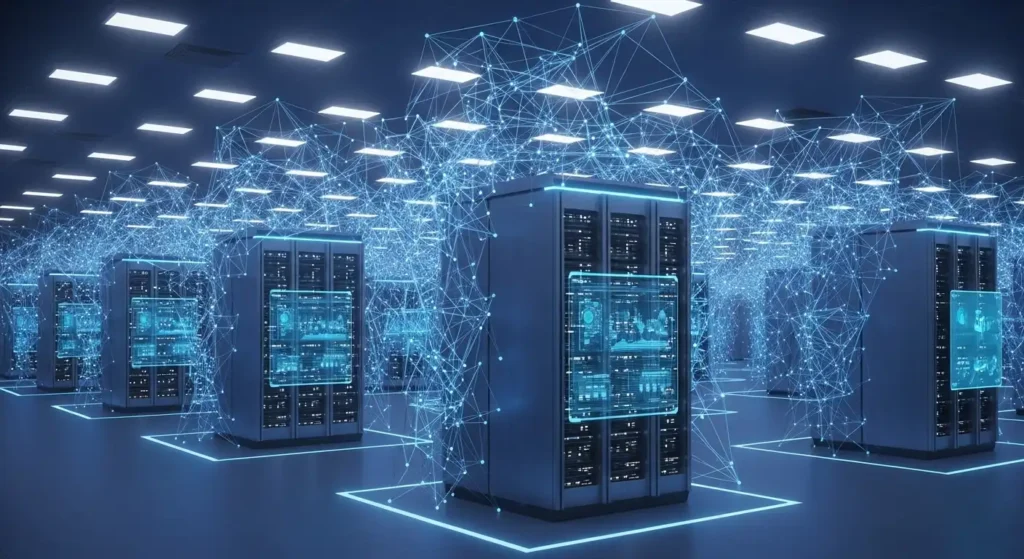
 To understand the mesh, we must first define the agent. Unlike standard chatbots, an AI Agent is a program capable of independent action—it can browse the web, execute code, manage databases, and make decisions based on a set of objectives. An AI Agent Mesh is the specialized cloud infrastructure that allows hundreds or thousands of these agents to communicate, share memory, and hand off tasks to one another in real-time.
Think of it as the difference between a solo musician (a single AI tool) and a symphony orchestra (the mesh). The orchestra needs a conductor and a specifically designed concert hall to function; in the digital world, the AI Agent Mesh Cloud Hosting environment is that hall.
The Technical Necessity for Mesh Infrastructure
Standard cloud hosting was designed for a linear request-response model: a user clicks a button, and the server sends data back. However, AI agents generate a massive amount of “east-west” traffic—meaning they talk to each other more than they talk to the human user.
1. High-Density Compute Requirements
AI agents don’t just sit idle. They are constantly performing “inference”—the process of running a trained AI model to make a prediction or generate text. This requires high-density compute power, often utilizing specialized GPUs (Graphics Processing Units) or NPUs (Neural Processing Units). Traditional shared hosting cannot handle these bursts of activity, making dedicated cloud environments essential.
2. Low-Latency Inter-Agent Communication
When Agent A (a researcher) needs to send data to Agent B (a writer), every millisecond of latency counts. If your hosting infrastructure isn’t optimized for this “handshake,” the entire autonomous workflow slows down. 2026 hosting standards now prioritize internal backplane speeds to ensure the mesh remains responsive.
How AI Agent Meshes Change the Hosting Game
The transition to mesh-native hosting introduces several paradigm shifts for site owners and developers:
- Persistent Memory Layers: Agents need to remember what they did yesterday. Modern hosting now includes “Vector Database” layers as a standard feature, allowing agents to store and retrieve “embeddings” (mathematical representations of memory) instantly.
- Autonomous Scaling: In a mesh environment, the infrastructure itself is an agent. If the system detects a spike in task complexity, it can automatically provision more compute power without human intervention.
- Decentralized Verification: To prevent “AI hallucinations,” meshes often use one agent to check the work of another. Hosting providers are now building “Truth Zones” where these verification processes can happen securely.
Security in the Age of Autonomous Agents
One of the biggest concerns with AI Agent Meshes is the “Who is responsible?” question. If an agent makes an unauthorized purchase or leaks data, who is at fault? This has led to the rise of Identity for Agents (IfA).
Cloud hosting providers are now issuing digital certificates not just to domains, but to individual AI agents. This ensures that only verified agents can join your mesh. When choosing your next hosting plan, look for features like “Zero-Trust Agent Architecture.” This ensures that even if one part of your site is compromised, the autonomous agents cannot be hijacked to perform malicious tasks.
Implementing an AI Strategy for Niche Sites
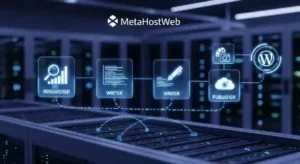 For those managing a network of sites or a PBN, the AI Agent Mesh is a force multiplier. Instead of manually writing pillar posts, you can deploy a mesh where:
- Agent 1: Scrapes current 2026 trends and identifies content gaps.
- Agent 2: Drafts a 1,200-word SEO-optimized post.
- Agent 3: Generates photorealistic prompts for the featured image.
- Agent 4: Uploads the draft to WordPress and handles internal linking.
This entire workflow requires a robust Cloud Hosting setup that won’t throttle your API connections or time out during long-running scripts.
The Cost-Benefit Analysis of AI-Native Hosting
While AI-optimized cloud hosting generally carries a higher price tag than budget shared hosting, the ROI (Return on Investment) is found in efficiency. By automating the “thinking” and “executing” parts of your business, you reduce the need for large content teams. However, it is vital to choose the right hosting for your business size to avoid overpaying for resources you aren’t yet utilizing.
Future Outlook: Beyond 2026
As we look toward 2027 and beyond, we expect to see “Self-Healing Infrastructure.” This is a mesh that doesn’t just host your site, but actively fixes broken links, updates its own WordPress plugins, and defends against DDoS attacks in real-time without a human ever logging into a dashboard.
The “Frontier” is no longer just about the AI model itself—it is about where that AI lives. Hosting is becoming the “nervous system” of the digital world, and the Agent Mesh is the evolution we have all been waiting for.
Conclusion
The move toward AI Agent Mesh Cloud Hosting represents the most significant architectural change in web history since the transition from static HTML to dynamic databases. By understanding these components—compute density, low-latency communication, and autonomous scaling—you can position your digital assets to thrive in an automated future.
Don’t let your hosting be a bottleneck for your innovation. Evaluate your current provider’s roadmap for AI support and ensure you have the infrastructure needed to support the agents of tomorrow.