

For the last decade, the hosting industry has been obsessed with a single word: automation. We celebrated when we could finally auto-scale a server or click a button to install WordPress. But as we move deeper into 2026, simple automation is no longer the “gold standard”—it is the bare minimum. The digital landscape has shifted from running static code to hosting autonomous entities.
Enter the AI Agent Mesh. This architectural shift is currently the most significant trend in cloud infrastructure, yet many website owners are still hosted on “dumb” servers that can’t support the agentic future. If you want your website to do more than just exist—if you want it to think, protect itself, and optimize in real-time—your next hosting choice must be built on an agent mesh.
What is an AI Agent Mesh?
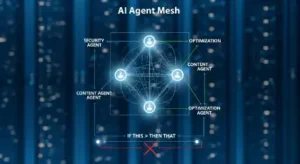
In 2025, we saw the rise of individual AI agents—tools that could handle customer support or write SEO meta descriptions. However, these agents often worked in silos. An AI Agent Mesh is a decentralized network within your hosting environment that allows these disparate agents to communicate, share data, and collaborate securely.
Think of it like a symphony. In standard automation, you have a CD player (the server) playing a pre-recorded track. In an AI Agent Mesh, you have a live orchestra. The “Security Agent” notices a suspicious traffic spike and immediately whispers to the “CDN Agent” to reroute traffic, while the “Optimization Agent” scales up CPU resources to handle the load—all without a single human intervention or a static script.
The Shift from Automation to Agentic Hosting
Why is AI Agent Mesh hosting becoming a necessity? The answer lies in the complexity of modern web applications. Traditional automation follows “If-This-Then-That” logic. If your traffic hits 80% capacity, then the server adds more RAM. This is reactive and rigid.
Agentic hosting is proactive. AI agents within the mesh possess “agency”—the ability to make decisions based on goals rather than just rules. When these agents are meshed together, they create a holistic ecosystem that manages your website’s health with a level of nuance that traditional managed hosting simply cannot match.
3 Reasons Your Next Host Must Support an Agent Mesh
1. Cross-Agent Security (The “Immune System” Effect)
Cyber threats in 2026 are faster and more adaptive than ever. A mesh architecture allows your security protocols to act like a biological immune system. Instead of waiting for a firewall to flag a known signature, a “Monitoring Agent” detects behavioral anomalies and alerts the “Access Agent” to challenge specific user tokens. Because they are on a mesh, the information is shared instantly across your entire infrastructure, creating a fortress that learns in real-time.
2. Intelligent Resource Allocation (FinOps 2.0)
We’ve all dealt with “cloud bill shock.” Standard cloud hosting often over-provisions resources just to be safe, costing you money. In an AI Agent Mesh, a “Financial Agent” monitors the real-time cost-to-performance ratio. If it sees that a specific process is consuming too much expensive compute power, it can negotiate with the “Task Agent” to move that process to a more cost-effective regional server or a different model entirely, significantly lowering your monthly overhead.
3. Seamless Content & SEO Synchronization
 Imagine your hosting environment hosting an “SEO Agent” that doesn’t just check keywords, but communicates with the “Image Processing Agent.” As you upload a new post, the mesh automatically optimizes the image for the current 2026 Core Web Vitals, updates the schema markup, and alerts your “Social Agent” to prepare a summary for distribution. This level of interconnectedness is only possible when agents aren’t just plugins, but are baked into the hosting mesh.
The Infrastructure Requirements for 2026
You cannot run an AI Agent Mesh on a standard shared hosting plan from 2020. This new era requires specific hardware and software benchmarks:
- Low-Latency Inter-Agent Communication: The “mesh” requires ultra-fast internal networking so agents can talk to each other in milliseconds.
- Model Agnostic Frameworks: Your host should allow agents to pull from different LLMs (Large Language Models) depending on the task—using a lightweight model for logging and a heavy model for creative generation.
- Privacy Sandboxing: Crucially, an agent mesh must have strict data silos. Your “Customer Support Agent” should be able to access the data it needs without exposing your “Financial Agent’s” records.
Is It Time to Migrate?
The transition to agent-ready hosting is similar to the transition from physical servers to the cloud. At first, it seems like a luxury; then, it becomes a competitive necessity. If your competitors are using an AI Agent Mesh to keep their sites faster, cheaper, and more secure around the clock, staying on traditional infrastructure becomes a liability.
When shopping for your next provider, don’t just ask about uptime and SSD space. Ask about their agent orchestration capabilities. Ask if their infrastructure supports autonomous agent coordination. The future of the web is no longer just about being online; it’s about being intelligent.
Conclusion
As we look toward the remainder of 2026, the distinction between “hosting” and “intelligence” will continue to blur. The AI Agent Mesh is the foundation of this new era. By moving to a host that supports agentic collaboration, you aren’t just buying space on a server—you’re hiring a digital workforce that never sleeps, never misses a security patch, and constantly optimizes your bottom line.