

The global web hosting and cloud infrastructure industry is approaching a fundamental inflection point in cryptographic security. For decades, the security of online communications—ranging from e-commerce transactions and administrative control panels to private API endpoints—has relied entirely on public-key cryptosystems like RSA (Rivest–Shamir–Adleman) and ECC (Elliptic Curve Cryptography). These mathematical structures form the backbone of modern SSL/TLS certificates and SSH key authentication.
However, the rapid advancement of quantum computing introduces an unprecedented vulnerability. Algorithms such as Shor’s Algorithm have demonstrated that a sufficiently powerful quantum computer—specifically a Cryptographically Relevant Quantum Computer (CRQC)—can break classical RSA and ECC encryption schemes in a matter of hours. To safeguard web servers, domain environments, and hosting infrastructure against future decryption threats, the web hosting industry must aggressively shift toward Post-Quantum Cryptography in Web Hosting.
Understanding the Quantum Threat: The “Harvest Now, Decrypt Later” Vulnerability

A common misconception among system administrators and web hosting providers is that quantum-resistant security can wait until functional quantum computers are commercially operational. This perspective fails to account for a pervasive cyber espionage strategy known as “Harvest Now, Decrypt Later” (HNDL).
Malicious actors, state-sponsored entities, and automated web scrapers are currently intercepting and storing vast volumes of encrypted web traffic, SSH administrative sessions, and sensitive hosting backups. While attackers cannot decrypt this data today, they are stockpiling it until quantum hardware achieves the required qubit capacity. Once a CRQC becomes operational, all retroactively harvested traffic secured with RSA or ECC will be decrypted simultaneously, exposing historical passwords, API keys, customer database dumps, and private configuration files.
Transitioning web hosting infrastructure to quantum-resistant standards ensures that data intercepted today remains mathematically secure even against tomorrow’s quantum processing capabilities.
NIST Standardization: The New Cryptographic Primitives
The foundation of this global migration was established by the National Institute of Standards and Technology (NIST) through its multi-year Post-Quantum Cryptography Standardization project. NIST formally released its finalized quantum-resistant cryptographic standards, designating specific algorithms for key encapsulation and digital signatures:
- FIPS 203 (ML-KEM): Module-Lattice-Based Key-Encapsulation Mechanism (derived from CRYSTALS-Kyber), designed for general encryption and secure key exchange protocols in SSL/TLS.
- FIPS 204 (ML-DSA): Module-Lattice-Based Digital Signature Algorithm (derived from CRYSTALS-Dilithium), built for primary digital signatures and SSL/TLS server certificate authentication.
- FIPS 205 (SLH-DSA): Stateless Hash-Based Digital Signature Algorithm (derived from SPHINCS+), offering an alternative signature scheme that does not rely on lattice assumptions.
For web hosting environments, ML-KEM and ML-DSA represent the core algorithms required to upgrade web server handshakes and SSH authentication routines.
Migrating Web Server Infrastructure to PQC-Ready SSL/TLS
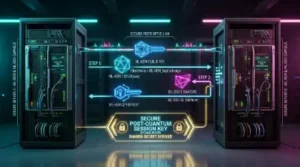
Upgrading web server stacks (such as Nginx, Apache, and LiteSpeed) to support post-quantum SSL/TLS requires shifting to hybrid key exchange models. Hybrid mechanisms combine a classical algorithm (like ECDHE) with a post-quantum algorithm (like ML-KEM) within a single TLS 1.3 handshake. This guarantees that if a flaw is discovered in a new post-quantum algorithm, the classical encryption layer still maintains traditional baseline defense.
Step 1: OpenSSL 3.x and Quantum-Safe Crypto Providers
Modern Linux distributions powering production web servers (such as Ubuntu 24.04 LTS or AlmaLinux 9) utilize OpenSSL 3.x. Implementing PQC requires compiling or linking web server binaries against quantum-enabled crypto providers, such as OpenSSL modules paired with the Open Quantum Safe (OQS) project (liboqs).
Step 2: Configuring Nginx for Hybrid TLS 1.3 Handshakes
Once the underlying cryptographic libraries support ML-KEM, web hosting administrators can update their web server configuration files to enable post-quantum key exchange groups. Below is an example Nginx configuration leveraging hybrid post-quantum TLS 1.3 groups:
# Enable TLS 1.3 exclusively for modern PQC key exchanges
ssl_protocols TLSv1.3;

# Configure hybrid Post-Quantum key exchange groups (X25519 + ML-KEM-768)
ssl_ecdh_curve x25519_kyber768:X25519:secp256r1;

# Enforce server cipher preferences
ssl_prefer_server_ciphers on;
ssl_ciphers "ECDHE-ECDSA-AES128-GCM-SHA256:ECDHE-RSA-AES128-GCM-SHA256";
When a supported browser (such as modern Chromium-based browsers running post-quantum cipher suites) connects to the host, the TLS 1.3 handshake automatically establishes an ML-KEM hybrid session.
Securing Remote Administration: Transitioning SSH Protocols
While SSL/TLS protects public-facing web traffic, SSH (Secure Shell) secures administrative access to server nodes, hypervisors, and hosting control panels. Securing SSH against quantum threats is equally vital for system maintainers.
Recent versions of OpenSSH have introduced support for quantum-resistant key exchange algorithms out of the box, notably combining ECDH Curve25519 with Streamlined NTRU Prime (sntrup768x25519-sha512@openssh.com) alongside newer ML-KEM integrations.
Updating OpenSSH Server Configuration
To enforce post-quantum key exchange mechanisms across your host fleet, update the server-side SSH configuration (/etc/ssh/sshd_config):
# Restrict KEX (Key Exchange) to hybrid post-quantum algorithms
KexAlgorithms sntrup768x25519-sha512@openssh.com,mlkem768x25519-sha512@openssh.com,curve25519-sha256

# Restrict host key algorithms to strong digital signatures
HostKeyAlgorithms rsa-sha2-512,ssh-ed25519
Restart the SSH service (systemctl restart sshd) to apply changes. Client connections attempting to establish administrative sessions will negotiate key exchange via post-quantum hybrid channels.
Technical Overhead & Performance Challenges for Web Hosts
Migrating to post-quantum cryptography introduces specific operational challenges that cloud architects and hosting engineers must manage proactively:
- Increased Packet & Key Size: Post-quantum public keys and ciphertexts are significantly larger than classical counterparts. For example, an RSA 2048-bit public key is roughly 256 bytes, whereas an ML-KEM-768 public key exceeds 1,100 bytes. This expansion increases packet sizes during the initial TLS handshake.
- Network Fragmentation & Latency: Larger cryptographic signatures can exceed the standard Maximum Transmission Unit (MTU) size of 1500 bytes, causing TCP packet fragmentation over intermediate network hops and adding minor latency to connection establishment times.
- CPU Processing Demands: While symmetric encryption speed remains unaffected once a session is established, the CPU overhead during initial key agreement and certificate signature verification increases. High-density web servers must be sized with modern CPU instruction sets to mitigate handshake bottlenecks.
Infrastructure Roadmap for PQC Compliance
Achieving total post-quantum readiness across a web hosting platform requires a structured engineering approach:
- Inventory Cryptographic Assets: Conduct a comprehensive scan of all active certificates, internal service mesh connections, database encryption keys, and SSH access controls.
- Upgrade Edge Proxies & CDNs: Deploy post-quantum hybrid TLS on edge reverse proxies, load balancers, and Content Delivery Networks (CDNs) to offload handshake overhead before traffic hits origin servers.
- Issue Hybrid Certificates: As Certificate Authorities (CAs) roll out dual-signed and post-quantum SSL certificates, systematically replace legacy RSA-only certs across public web properties.
- Enforce SSH Key Rotation: Phase out older SSH keys across devops teams and require hybrid PQC key pairs for remote server access.
Conclusion
Post-quantum cryptography is no longer a theoretical security topic reserved for academic researchers—it is an operational requirement for modern web hosting infrastructure. By deploying hybrid SSL/TLS handshakes, upgrading OpenSSH configurations, and preparing server hardware for NIST-standardized algorithms, hosting providers can defend customer data against present-day collection and future quantum decryption. Taking proactive steps today ensures your server environment remains secure, resilient, and fully compliant in the post-quantum web era.