

The Thermal Envelope Problem: Why Air Cooling Is Hitting a Wall
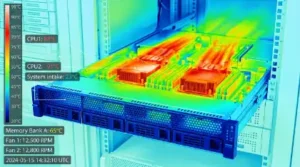 To understand the necessity of liquid cooling, one must look at power density per server rack. Traditionally, a standard web hosting server rack drew anywhere between 4 kW and 10 kW of power. Air cooling systems could easily move enough cubic feet of air per minute (CFM) across heatsinks to maintain optimal junction temperatures for multi-core CPUs and basic accelerator cards.
Today, high-density server configurations deployed for enterprise AI hosting, deep learning, and advanced cloud virtualization routinely demand 30 kW, 50 kW, or even upwards of 100 kW per rack. Modern enterprise processors and specialized GPU accelerators produce unprecedented thermal output per square inch of silicon.
Air is an inefficient conductor of heat compared to liquids. When air-cooled fans run continuously at maximum RPM to cool dense nodes, several operational challenges immediately arise:
- Thermal Throttling: As junction temperatures peak, CPUs and GPUs automatically dial back clock speeds to prevent physical damage, leading to latency spikes for hosted applications.
- Exponential Fan Power Consumption: Running high-velocity chassis fans across hundreds of rack units consumes massive amounts of electricity simply to move air, drastically inflating operational expenses.
- Acoustic and Physical Limits: High-CFM fans create extreme acoustic pressure and vibration within server chassis, accelerating mechanical component failure over time.
Liquid Cooling Technologies: Direct-to-Chip vs. Immersion Systems
To solve the thermal bottleneck, hosting providers are deploying two primary liquid cooling architectures depending on their density requirements and hardware layouts.
1. Direct-to-Chip (Cold Plate) Liquid Cooling
Direct-to-chip liquid cooling—also known as warm-water cooling or liquid-to-plate—is currently the most widely adopted approach for hybrid web hosting platforms. Sealed metal cold plates containing micro-channels are mounted directly atop high-TDP components like CPUs, GPUs, and memory modules.
A closed-loop system circulates dielectric fluid or specially treated water through the cold plates, absorbing heat directly at the silicon level. The heated fluid is then routed to a heat exchanger or outdoor dry cooler, chilled, and recirculated back into the server manifold. Because the liquid targets the primary heat sources directly, surrounding low-wattage components (such as storage drives and power supplies) can still be managed with minimal ambient airflow, allowing hosts to retrofit existing rack infrastructure efficiently.
2. Single-Phase & Two-Phase Immersion Cooling
For ultra-high-density deployments—such as dedicated AI clusters and bare-metal compute pools—immersion cooling represents the ultimate thermal solution. Instead of relying on closed tubes, entire specialized server blades are completely submerged in a bath of non-conductive, dielectric fluid.
In single-phase immersion cooling, the fluid flows continuously around the active server components, absorbing heat directly before being pumped to an external heat exchanger. In two-phase immersion cooling, the fluid has a low boiling point; it boils directly off the hot components, vaporizes, rises to a condenser coil at the top of a sealed tank, condenses back into liquid, and drips back into the bath. Immersion cooling completely eliminates server fans, dramatically reduces noise, and protects sensitive electronics from oxidation, dust, and moisture.
Improving PUE, Sustainability, and Operational Cost Efficiency
Beyond raw performance and hardware stability, the shift toward liquid cooling directly addresses one of the web hosting industry’s biggest metrics: Power Usage Effectiveness (PUE). PUE measures how efficiently a data center uses energy, calculated as total facility energy divided by the energy delivered to actual IT equipment. An ideal PUE score is 1.0.
| Cooling Infrastructure Type | Average Power Density Per Rack | Typical Facility PUE Range |
|---|---|---|
| Traditional Air-Cooled (CRAC/HVAC) | 5 kW – 15 kW | 1.4 – 1.7 |
| Direct-to-Chip Liquid Cooling | 30 kW – 80 kW | 1.15 – 1.25 |
| Total Immersion Liquid Cooling | 100+ kW | 1.02 – 1.08 |
Because liquids hold heat far better than air—water transfers heat roughly 24 times faster than air—liquid cooling systems require significantly less electrical energy to keep hardware at optimal operating temperatures. Lowering auxiliary cooling overhead directly translates to lower operational costs for web hosts, allowing them to offer enterprise-grade bare-metal performance, high-frequency VPS instances, and AI API hosting at far more competitive price points.
What Businesses Should Look For in Next-Gen Cloud Hosts
 If your organization deploys resource-intensive applications, automated pipelines, real-time analytics, or custom machine learning models, choosing a host backed by high-density, liquid-cooled infrastructure offers distinct advantages:
- Predictable Compute Performance: Liquid-cooled nodes maintain consistent CPU and GPU clock speeds without thermal throttling during peak compute bursts.
- Higher Compute Density in Smaller Footprints: High-density racks allow providers to house more raw processing power per square foot, making dedicated node allocation faster and more cost-effective.
- Enhanced Component Longevity and Reliability: Operating in temperature-stable environments with reduced thermal cycle stress dramatically lowers hardware failure rates, ensuring higher overall SLA uptime for critical services.
Final Verdict
The transition to liquid cooling is no longer limited to niche supercomputing centers or specialized labs. As artificial intelligence and high-density compute requirements filter into mainstream web applications, cloud hosting platforms must evolve. By adopting direct-to-chip and immersion liquid cooling architectures, forward-thinking web hosts are successfully driving down PUE, maximizing hardware efficiency, and delivering the high-performance computing power modern digital businesses demand.